 English
 Français

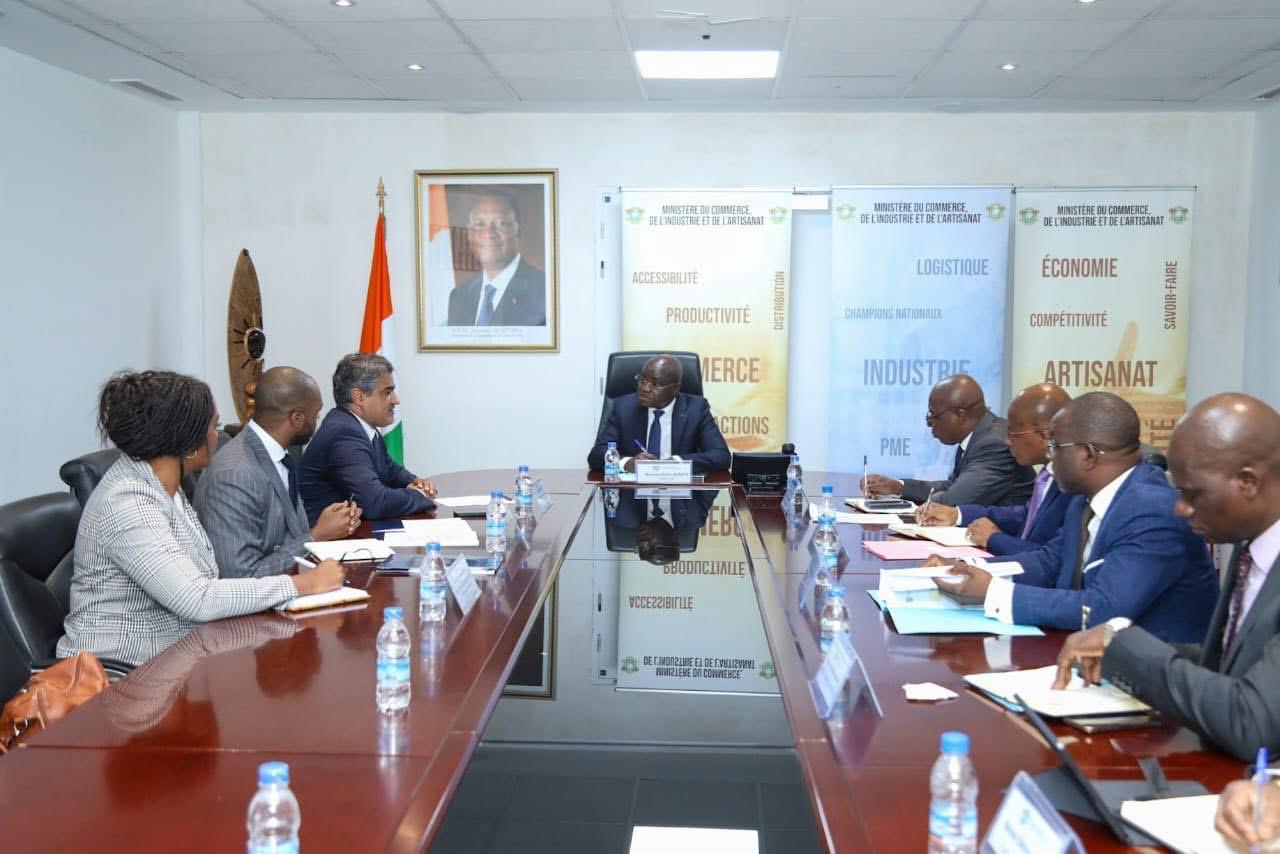
Received by the Minister of Commerce, Industry and Crafts, Ibrahim Khalil Konaté, the Chargé d'affaires of the United States Embassy in Abidjan, Junaid (Jay) Munir praised the role played by his host in the development of bilateral economic relations. The discussions focused on American trade priorities in Côte d'Ivoire as well as the prospects for increasing investment flows and trade. The two countries already have a dynamic economic relationship. According to data from the Office of the United States Trade Representative (USTR), trade in goods and services between the United States and Côte d'Ivoire reached $1.9 billion in 2024, an increase of 12.3% compared to the previous year. Trade alone represented $2.6 billion in 2025. American exports to Côte d'Ivoire amounted to nearly $644.4 million in 2025, an increase of 9% ($53.2 million) compared to 2024. While American imports from Côte d'Ivoire reached $148 million in 2024, an increase of 34.5% (38 million dollars) compared to 2023.
Constantly increasing trade
Côte d'Ivoire is today establishing itself as one of the leading African agricultural suppliers to the United States. Cocoa remains the flagship product of Ivorian exports to the American market. In 2024, Ivorian agricultural exports to the United States represented $816.2 million, including $758.5 million for cocoa and its derivative products. Natural rubber, cashew nuts and wood are also among the main products shipped across the Atlantic. Beyond these raw materials, several sectors still offer significant room for improvement. Experts from the Carnegie Endowment for International Peace estimate that Ivorian exports to the United States remain more than 99% concentrated on five product categories, including cocoa, oil, rubber, cashew nuts and wood. This low diversification suggests opportunities in industrial processing, agri-food products based on local raw materials, coffee, spices and even manufactured products with higher added value. The preferential access granted by the African Growth and Opportunity Act, better known as AGOA, constitutes another development lever. This American program allows several thousand African products to enter the American market without customs duties. Côte d’Ivoire has benefited from this system for several years. The American authorities also point out that the country remains eligible for this program in 2026. The United States and the West African Economic and Monetary Union (UEMOA) have been linked since 2002 by a framework agreement on trade and investment.
Investment opportunities in several sectors
The prospects for cooperation go far beyond the sole area of agricultural exports. The Ivorian economy, one of the most dynamic in West Africa, is attracting more and more foreign companies thanks to macroeconomic stability, public investment in infrastructure and the growth of the domestic market. American companies thus have opportunities in agribusiness, energy, logistics, port infrastructure, digital technologies, financial services and health. The United States already exports petroleum products, plastics, chemicals, industrial equipment, vehicles and medical equipment to Ivory Coast. Hence US exports to the Ivorian market in 2025 reached more than $644 million, according to United Nations statistics compiled by Trading Economics. The industrial processing sector appears to be one of the main areas of cooperation to be developed. The world's leading producer of cocoa and leading exporter of raw cashew nuts, Côte d'Ivoire is seeking to increase the local processing of its raw materials in order to create more added value. American expertise, private capital and new technologies can contribute to the country's industrialization and job creation. Investments in the digital economy also represent significant potential. With a young population and a constantly increasing mobile phone penetration rate, Côte d'Ivoire offers opportunities in the areas of digital services, e-commerce and technological solutions. American companies specializing in innovation and digital services thus have a rapidly expanding market.
Note that the strengthening of the economic partnership between Washington and Abidjan comes in a context where Côte d'Ivoire seeks to diversify its commercial partners and accelerate its industrial transformation. For their part, the United States wishes to consolidate its economic presence in West Africa and support the rise of the continent's economies. The exchanges initiated between the American Chargé d'affaires and Minister Ibrahim Khalil Konaté demonstrate this common desire to make trade and investment engines of growth and shared prosperity between the two countries.